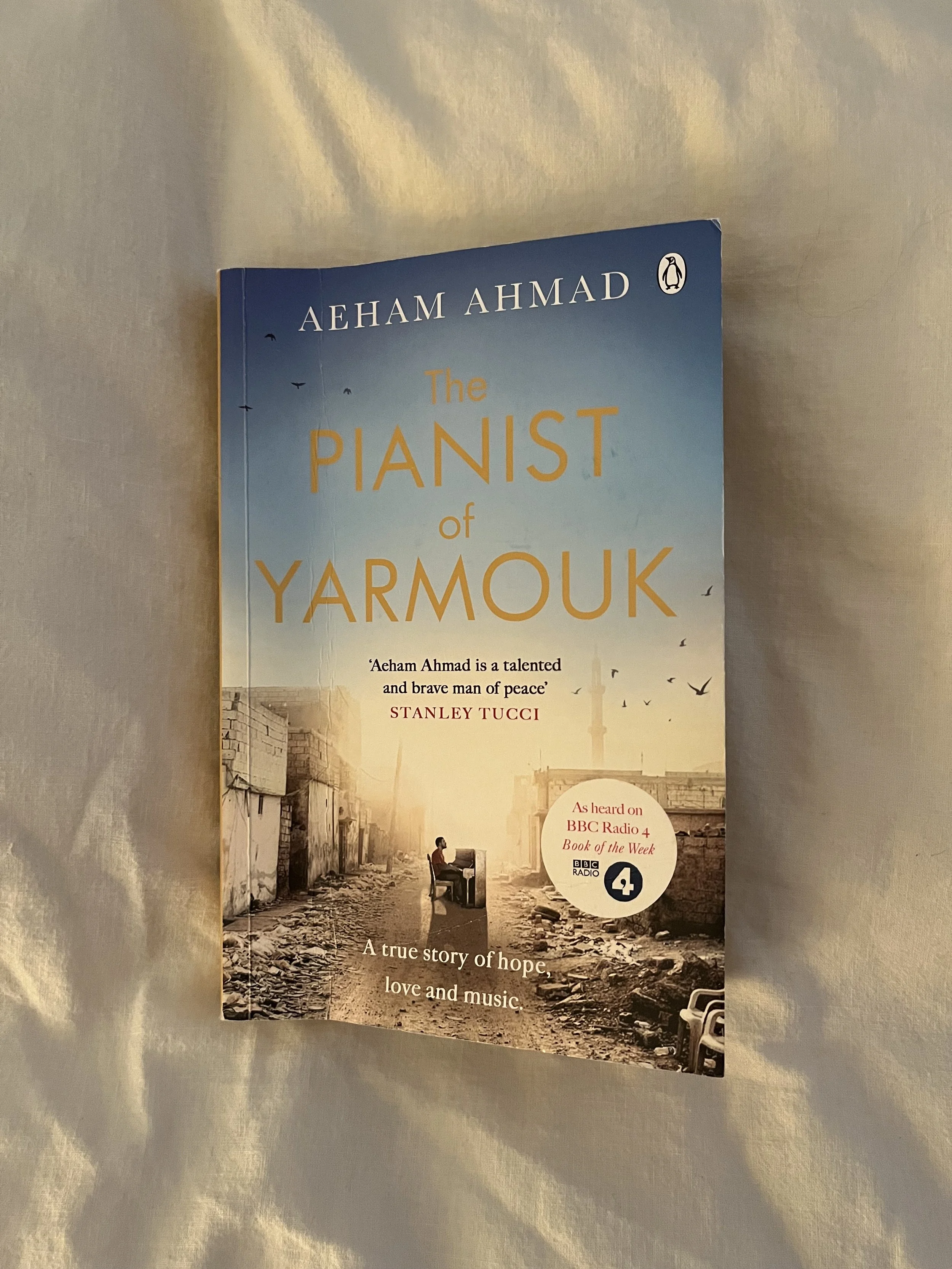
The Pianist of Yarmouk by Aeham Ahmad: Book Review
‘I’m a pianist. I’ve never waved flags. My
revolution is music. And the world began to listen.
It was a miracle.’
There are photographs captured during the Syrian conflict that will remain imprinted in our memories forever. One of those photographs is of Aeham Ahmad ‘sitting at a piano, singing a song amid the rubble of my [Aeham’s] neighbourhood.’ It was one of those images that moved hearts and minds across the world.
Aeham’s grandfather was Palestinian and forced to leave Palestine during the 1948 Nakba along with more than 700,000 other refugees. They arrived in Dili, a village in southern Syria (p.10). Aeham grew up in Yarmouk, an unofficial refugee camp located approximately eight kilometres from Damascus. Yarmouk suffered devastation during the conflict. Prior to the conflict the camp was home to around 160,000 refugees. By September 2024 the camp’s population had significantly decreased to over 10,000 (UNRWA).
By writing his memoir, Aeham reveals so much more than a single moment can tell. In the Prologue, Aeham tells us that he chose to write his story because he wanted to use his voice to explain why he was forced to leave his home. Aeham explains how he ‘would become one of those miserable grey figures, one of the now millions who were streaming into Europe.’ This is how Syrian refugees have so often been portrayed in mainstream media. Aeham’s memoir resists this image. Like every ‘grey figure’ in the images we see in mainstream media, Aeham has a unique story, a family he had to leave behind, a home destroyed and repeatedly forced to make decisions no human being should ever have to make. Through all of this, he has music and an inspiring passion for sharing it with people of all ages.
Aeham’s memoir spans from his childhood to 2016, a year after he had made it to Germany. The first quarter of the book is focused on recounting his childhood and relationship with his father, Ahmad. Aeham inherited his love of music from his father. One of the most fascinating parts about Aeham’s story is how he writes about him.
Ahmad became blind when he was eight years old through an accident at school. He grew up to be an incredible violinist through hours and hours of dedicated practice and pure enjoyment for the instrument. He also learnt how to tune pianos when he could not afford a piano tuner for Aeham and learnt how to build instruments by pulling them apart and rebuilding them. His patience and perseverance are incredibly inspiring.
Despite the conflict, music was still an unwavering part of Aeham’s family. It may have been distant at times, but it was a constant part of them; even in times of unimaginable loss and inhumane conditions, they could find moments of joy through music.
From the beginning Aeham repeatedly transitions from writing about childhood memories of music to painful memories of the conflict and day-to-day life under siege in Yarmouk. But as the book progresses, Aeham increasingly focuses on the siege, emphasising how this has become a new normal: loss, grief, fear, starvation, disease, a severe lack of medical care – the list goes on. Music takes on new meaning too:
‘I realised that I’d be willing to give up almost anything,
but not music. My music kept me alive.’ (p.184).
The reader is encouraged to stay present, never passive; taking in every detail explained and memory recounted. Through Aeham’s memories we learn how life in Yarmouk was rapidly falling into devastation and it was becoming harder to survive. Since the conflict began there have been reports about the targeting of schools and hospitals which became common occurrences. Aeham provides a personal account of how this felt. In a single day Aeham’s old middle school was targeted, as well as the birth clinic where his weeks old son had been born. (p.124).
Aeham’s memoir is also an important account of the heartbreaking challenges pregnant women and mothers faced. Aeham and his wife Tahani heard a woman screaming. It was a grandmother – her grandson was dying. His mother could not produce breast milk (pp.160-161). Many mothers were unable to breast feed their babies due to malnourishment and trauma. They were surviving on little food and water and Aeham explains how mothers would give up their own share to their children.
There have been reports and accounts from journalists such as Marie Colvin who died reporting in Homs in 2011, to David Knott, a surgeon who has worked in conflict zones including Syria, about the inhumanity that women and children were subjected to. Colvin’s report, ‘We Live in Fear of a Massacre’ puts on the record how women were feeding their babies sugar and water because they were traumatised and could not breastfeed. There was also no formula milk.[1]
The conflict decimated the health system and Aeham provides many further examples of how devastating this was.[2] Aeham recounts how he was selling falafel when a grenade exploded. A carpenter volunteered to surgically repair his fingers where a doctor was not available (p.146). This reminded me of a report in Homs by Colvin titled ‘A vet is only hope for Syrian wounded’ (19.02.2012). Doctors as well as medical supplies were scarce.
At the beginning of Chapter 19, Aeham references a photograph which was published in the Guardian on 5th March 2015.[3] Aeham describes people he knew in the photograph, friends of his parents and a school teacher. Aeham was waiting for his parents by a bare tree which you can see in the back of the photograph and his parents are there. Matching the people one by one in the photograph to the description brings the reader out of the book and actively engaging with another photograph. Just like Aeham is using words to provide context to his own photograph, he is doing the same with this one. He is encouraging the reader to focus on the people and remember everything he has told us. Photographs like memoirs are part of a collective memory of conflict. But they require us to actively engage rather than passively consume.
As I was writing this review, I was reminded of a phrase the war reporter Martha Gellhorn used numerous times throughout her career:
‘on the record’.
It was a phrase that was very important to her and drove her work. This is what Aeham is doing. He is writing for the record like so many have before him.
By using the memoir form to contextualise the photograph of himself, and later on engage us in an exercise to seek out his family and friends in another photograph. We are encouraged to think deeply about how we are reading stories about refugees. The power in reading these books truly lies in what we do afterwards. Do we close the book and place it on the bookshelf, or do we pass it on, talk about it and continue to remember for the next generation so they can do the same.
‘I’m a pianist. I’ve never waved flags. My
revolution is music. And the world began to listen.
It was a miracle.’
Conversations spark a ripple effect. Like music and photographs, stories and how we tell them can make the world listen too.
[1] ‘We Live in Fear of a Massacre’, Marie Colvin, The Sunday Times, 19.02.2012, https://mariecolvin.org/we-live-in-fear-of-a-massacre-marie-colvin.
[2] https://www.rescue.org/article/one-day-well-go-home-how-syrian-mothers-care-their-families-crisis.
https://www.unicef.org/stories/displaced-syrian-mothers-confront-hardship-determination. https://www.careinternational.org.uk/news-stories/how-women-in-syria-are-developing-new-skills-to-support-themselves-and-their-families-through-crisis/.[3] https://www.theguardian.com/news/2015/mar/05/how-yarmouk-refugee-camp-became-worst-place-syria.