Syria’s Secret Library: The true story of how a besieged Syrian town found hope by Mike Thompson: Book Review
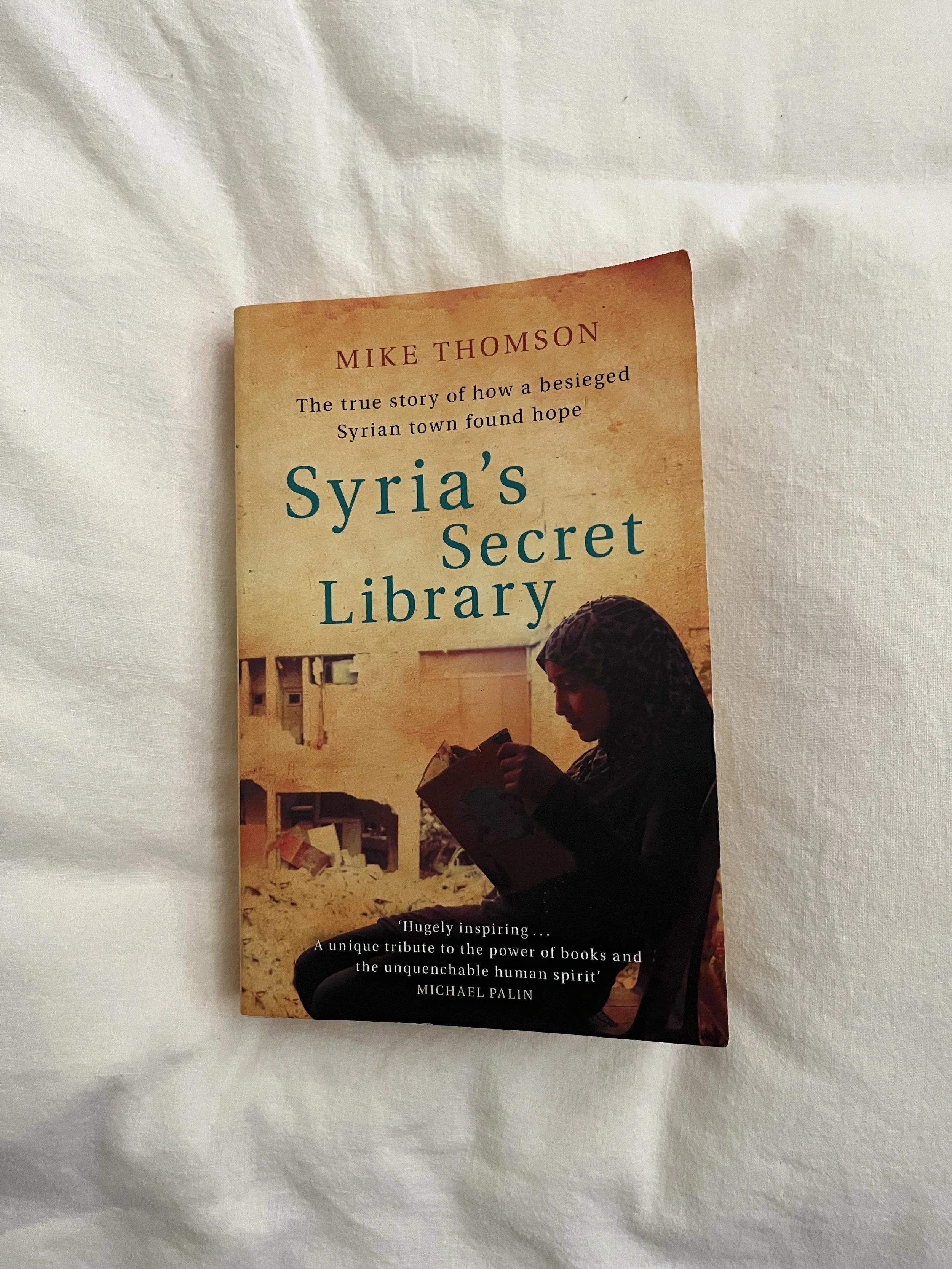
Syria’s Secret Library: The true story of how a besieged Syrian town found hope, published in 2019, is a story of incredible resilience, passion for education, and of a dream to rebuild Syria again.
Mike Thomson is a Foreign Correspondent for the BBC. Thomson heard about Daraya in 2015 through compiling a news report. He wanted to understand how the people of Daraya were surviving when it had been unable to receive aid. Pro-Syrian government forces had surrounded the town since November 2012 (p.4). He heard rumours about a secret library and set out to understand this story of hope amongst the devastating news reports about Syria.
‘From this moment on, a new optimism took hold in Daraya.
This literary haven offered more than an easy escape from
bombs and boredom. It was to become a portal to another
world: one of learning, one of peace, and one of hope.’ (p.82).
Daraya has a significant and long history and one that is punctuated with incredible stories of protest and resilience. According to Thomson, the town became known for its non-violent protests. For example, in 1998 a group of young men and women were studying the Quran with a progressive cleric and as a result were thrown out of the mosque. They were the Majmu’at Shabab Daraya (Youth Group of Daraya) who believed that ‘reading and learning were essential[…]to change society’. They created Daraya’s first free public library ‘Paths of Peace Library’. But eventually it was closed down by police and all the books confiscated (pp.14-16).
Thomson writes about secret library through the stories of the people who created it or came to pass through its doors. One of those people was Muhammad Shihadeh, an English teacher, who grew up during the Assad regime and its ‘repressive censorship’ ( p. 75). His entire academic experience from Primary School to university was controlled by the regime. Literature on recent Syrian history was not available. Students were arrested for reading ‘subversive’ books and some were even refused their degree certificates – nothing to prove their hard work and dedication. Muhammad also explained that the regime’s censorship not only took place in education, it also ‘permeated society’ so that it became ‘self-censorship’, avoiding books that would not be approved by the regime. This is where the Secret Library as a symbol of protest and resilience comes in – no book is off limits (p. 76).
‘Books, he [Omar Abu Anas] had insisted, whether
on the subject of literature, history, politics, religion,
poetry or anything else, can help show the way forward
and provide the building blocks for the years to come.’ (p. 292).
The secret library was a place where people could read widely and continue their education. Thomson writes about inspiring women, Sara (pseudonym), Amena, and Aysha, who created small schools for children. Sara and Amena’s school was held in a basement due to the bombing. It was a windowless and dark room with little to no electricity. It had to be hidden otherwise it was likely to be targeted.
Many children lost their formal education during the conflict. Action Syria’s January 2026 Programme Report states that at least 7000 schools have been damaged or destroyed as a result of 14 years of conflict. Sara would make the dangerous journey to the secret library, risking her life to do so. She met Amjad, a fourteen-year-old boy who discovered the secret library whilst ‘frantically searching for cover’ from shelling and snipers. He became Chief Librarian and used the library to continue his education. Amjad’s entire education took place at the secret library because his age meant formal schooling was unavailable to him (pp. 84-85). This is why the existence of charities and organisations like Action Syria and UNICEF are vital.
Action Syria carries out school rehabilitation projects such as the school restoration in Zamalka in partnership with Abjad Initiative for Education. Before the rehabilitation there were broken desks, damaged windows and the classrooms were dark. A twelve-year-old student called Khaled found it difficult to learn. Since the school rehabilitation he is thriving and dreams of becoming an engineer to rebuild his country. UNICEF also carry out school rehabilitations and creating innovative solutions to improve the capacity and functionality of the national education system. The Self Learning Programme for example is designed to transition children with no formal education back into the education system.
Whilst education and learning is at the forefront of Thomson’s book, the devastation on access to medical care is inevitably interwoven throughout the book. Sara for example explained the impact of starvation on learning. The teachers would cut photos of food out of the books because ‘’it would only stir emotions. It wasn’t fair on them.’’ (p.90).
As you will have likely seen in the media, the regime targeted hospitals and would also refuse aid agencies into Daraya (p.67). Ayham, was studying to become a Dentist at Damascus University when the conflict began and was the only resident in Daraya who could care for people’s teeth (p.132). He decided to stay and borrowed books from the secret library to fill knowledge gaps to care for people. But as Thomson explains, the main challenge was acquiring medical equipment and resources. Imagine also having no access to clean drinking water. The regime cut supplies leading residents to go to wells to collect water. But to be safe to drink and use this had to be boiled. The regime had cut main supplies to electricity and access was rarely available (p. 68). Faced with these conditions, Ayham’s compassion and dedication is incredibly brave, and his work made possible by having access to the secret library.
Thomson reminds us that many brave and courageous people across history have set up secret libraries in response to censorship. In the 1930s, ‘Jews set up secret libraries in the ghettoes of occupied Europe’ as the Nazis were destroying Jewish books, newspapers, as well as anything critical of the Nazis ideology (p. 78). Continuing to educate, read, and share knowledge is a powerful act of a resistance against a regime that wants to destroy anything that does not conform to their ideology. This is what makes the people of all secret libraries so inspiring. Thomson phrases this perfectly:
‘But perhaps the most remarkable factor of all was not
the building itself, nor the many thousands of books within
it. it was the people who created it. Those who risked their
lives to fill its shelves, arranged lectures and book groups,
logged its titles and scrubbed its floors. The people who never
lost faith in the value of culture and humanity in such terrible
times.’ (p.103).
Remarkable is absolutely right.